
You are here:
Quick menu
Acuity OCR


General information
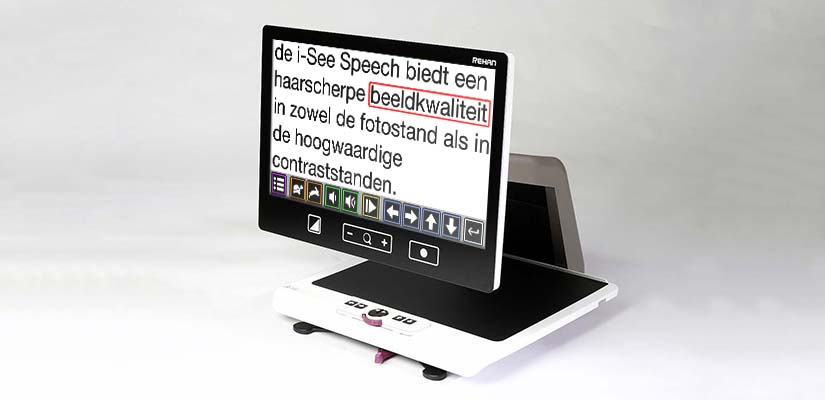
The Acuity OCR is the newest addition to the low vision range. It combines the innovative Acuity Basic with a text-to-speech function to meet an important need.
We have combined the extremely user-friendly and popular Acuity with a text-to-speech function. When you become fatigued with reading you can simply switch from the reading to the text-to-speech function to continue going through the text. You can easily set the section of the text that you wish to have read out loud.
The i-See Speech is operated with user-friendly buttons under the Full HD panel that we developed in house. The Full HD camera and Full HD panel yield very sharp and stable images at all magnifications.
The electronic magnifier is also available with optional controls in the table. The Acuity OCR, like the i-See and Acuity Basic, has a fast and silent autofocus and is equipped with bright illumination that lasts the service life.
Request a price
Request a demo
Product specifications
Text-to-speech function:
- Full HD camera in combination with 22 inch full HD monitor
- Text-to-speech function with moveable A3 XY table
- Touch controls under the monitor
- Crop mode for specific applications
- Magnification from 1X to 65X (full A4 width is displayed)
- Ten high-contrast and three photo modes
Text-to-speech function:
- Text read out loud
- Language recognition
- Language and voice options (up to 5 languages)
- Operation with Full Touch monitor
- Wireless Bluetooth remote control (optional)
- Document saving
- Zone detection
- Volume and reading speed adjustable
- Text navigation
Documentation
Frequently asked questions
An electronic magnifier is a magnifying aid that consists of a monitor and a camera above a table. An electronic magnifier is sometimes referred to as a ‘TV magnifier’ or ‘CCTV’ (Closed Circuit Television).
You place the object you wish to view (such as printed or handwritten text or a photo, etc.) on the table. The magnified object is then displayed on the monitor, with more contrast if you so require.
Electronic magnifiers have a range of functionality. All have a number of high-contrast modes that are ideal for reading text. These high-contrast modes increase the contrast to make the letters more legible. A range of contrasting text and/or background colours are also available. In addition to offering increased contrast, electronic magnifiers also have photo modes for the display of photos and other image material in bright colours. Electronic magnifiers with a text-to-speech function are also available.
You qualify for an electronic magnifier when you have been diagnosed with a visual impairment to a degree that makes it impossible or almost impossible to read without this aid.
First of all, people with low vision for whom glasses or a handheld magnifier is no longer sufficient. Our electronic magnifiers are used by people with disorders such as macular degeneration, retinitis pigmentosa, diabetic retinopathy, glaucoma and cataracts.
At home, work, school and elsewhere.
This must in any case state the explicit reasons and your medical data. The applicant is usually an ophthalmologist, the physician who is treating you or an institution for the blind and visually impaired. A GP cannot usually prescribe an electronic magnifier.
Your GP will usually refer you to an ophthalmologist or other specialist. You can contact us for an address in your neighborhood.
- What is an electronic magnifier?
-
An electronic magnifier is a magnifying aid that consists of a monitor and a camera above a table. An electronic magnifier is sometimes referred to as a ‘TV magnifier’ or ‘CCTV’ (Closed Circuit Television).
- How does an electronic magnifier work?
-
You place the object you wish to view (such as printed or handwritten text or a photo, etc.) on the table. The magnified object is then displayed on the monitor, with more contrast if you so require.
Electronic magnifiers have a range of functionality. All have a number of high-contrast modes that are ideal for reading text. These high-contrast modes increase the contrast to make the letters more legible. A range of contrasting text and/or background colours are also available. In addition to offering increased contrast, electronic magnifiers also have photo modes for the display of photos and other image material in bright colours. Electronic magnifiers with a text-to-speech function are also available.
- When do I qualify for an electronic magnifier?
-
You qualify for an electronic magnifier when you have been diagnosed with a visual impairment to a degree that makes it impossible or almost impossible to read without this aid.
- Who use Rehan Electronics’ electronic magnifiers?
-
First of all, people with low vision for whom glasses or a handheld magnifier is no longer sufficient. Our electronic magnifiers are used by people with disorders such as macular degeneration, retinitis pigmentosa, diabetic retinopathy, glaucoma and cataracts.
- Where can electronic magnifiers be used?
-
At home, work, school and elsewhere.
- Which conditions must be met by applications for electronic magnifiers?
-
This must in any case state the explicit reasons and your medical data. The applicant is usually an ophthalmologist, the physician who is treating you or an institution for the blind and visually impaired. A GP cannot usually prescribe an electronic magnifier.
- How can I contact a specialist who can prescribe this for me?
-
Your GP will usually refer you to an ophthalmologist or other specialist. You can contact us for an address in your neighborhood.